The Organic Act places the new federal capital under the direct rule of Congress. Residents of what had been Maryland and Virginia lose their vote for president, senators, and representatives.
The disenfranchisement was not debated. It was assumed. This is the baseline. Everything that follows is a fight against it.
Over President Andrew Johnson's veto, Congress granted Black men in DC the right to vote in local elections, three years before the Fifteenth Amendment extended the right nationally.
DC held the first interracial elections in American history. The city's Black residents organized, petitioned, and turned out. By 1868, the District had elected its first Black city councilmen. The experiment was real, and it was led by the people who lived here.
After a brief experiment in territorial government, Congress replaces elected leadership with three appointed commissioners. It will take a hundred years to get elections back.
But DC residents never stopped organizing. The coalition that would eventually win the 23rd Amendment and Home Rule began building in these years, through churches, civic associations, and the Black press.
After 160 years of organizing, through petitions, marches, and a decades-long campaign that stretched from Frederick Douglass through the NAACP, the Constitution is amended to give DC residents a vote for president.
Three-quarters of state legislatures agreed. Ratified in just over nine months.
Congress creates a non-voting delegate seat in the House. Walter E. Fauntroy, Baptist minister, King-era civil rights organizer, DC coordinator of the 1963 March on Washington, becomes the first person to represent DC in the Capitol in nearly a century.
A foot in the door is still a foot in the door. Fauntroy will hold the seat for twenty years, building the coalition that passes Home Rule in 1973 and the constitutional amendment in 1978.
The Home Rule Act restores elected local government to DC for the first time in a century. Walter E. Washington becomes the first elected mayor of the District of Columbia, and the first elected Black mayor of any major American city.
DC ran itself, by the people who lived there. The implications were national. The city's residents had proved they could govern, and the rest of the country noticed.
By bipartisan majorities in both chambers, Congress sends the DC Voting Rights Amendment to the states. It would have given DC two senators and full voting representation in the House. Equal citizenship, written into the Constitution.
Sixteen states ratified before the seven-year deadline. We came within 22 states of rewriting the Constitution, and most Americans don't know it almost happened.
Then it went to the states. 16 ratified.
The seven-year window closes. But the vote totals tell the story: every state that ratified did so because organizers on the ground made the case.
The coalition existed. The argument worked. The next attempt starts from a higher floor.
A bipartisan 61-37 Senate majority votes to give DC a voting representative in the House. The bill was the closest statutory fix in a generation.
It stalled in the House over an unrelated gun-law rider, not over DC representation itself. On the merits, the votes were there.
DC residents ratify a state constitution and formally petition Congress for admission. The mandate is overwhelming, larger than the margin by which most states were originally admitted to the Union.
The city is ready. The paperwork is done.
For the first time in American history, a chamber of Congress votes to admit the District of Columbia as a state. And then, the following year, it does it again.
Delegate Eleanor Holmes Norton spent thirty years building to this moment. A generation of DC organizers, from Home Rule veterans to Black Lives Matter Plaza, built the coalition that delivered the votes.
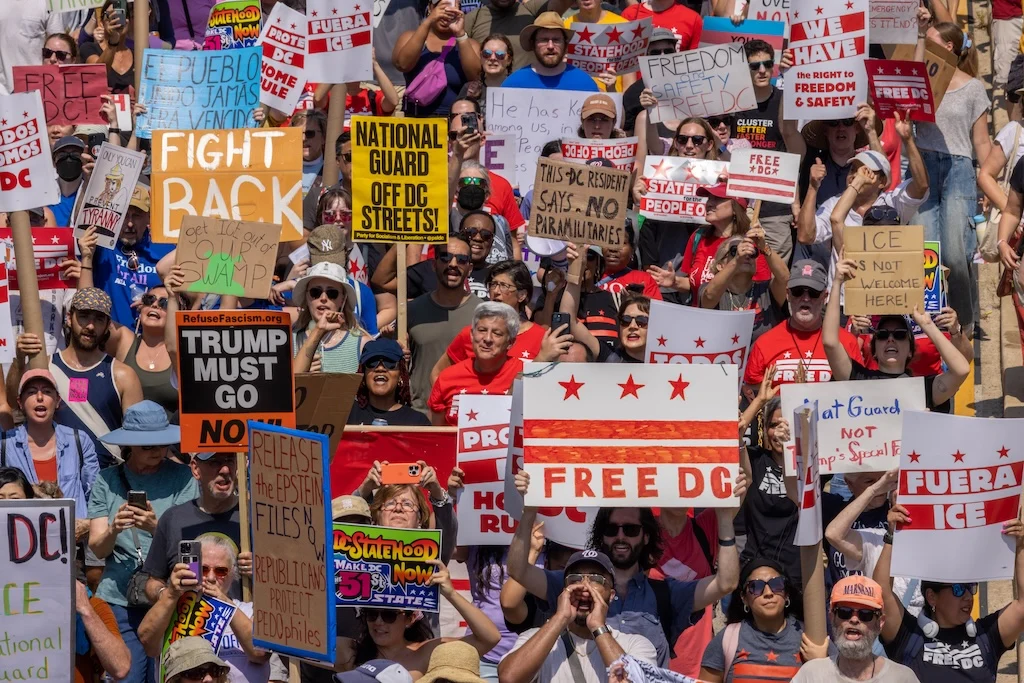
Congress is once again reaching into DC's daily life, overturning local laws, seizing tax revenue, federalizing the Metropolitan Police.
It is the moment that decides whether the gains of 1961, 1970, 1973, and 2021 hold. History says this is what the fight looks like right before the next breakthrough.